
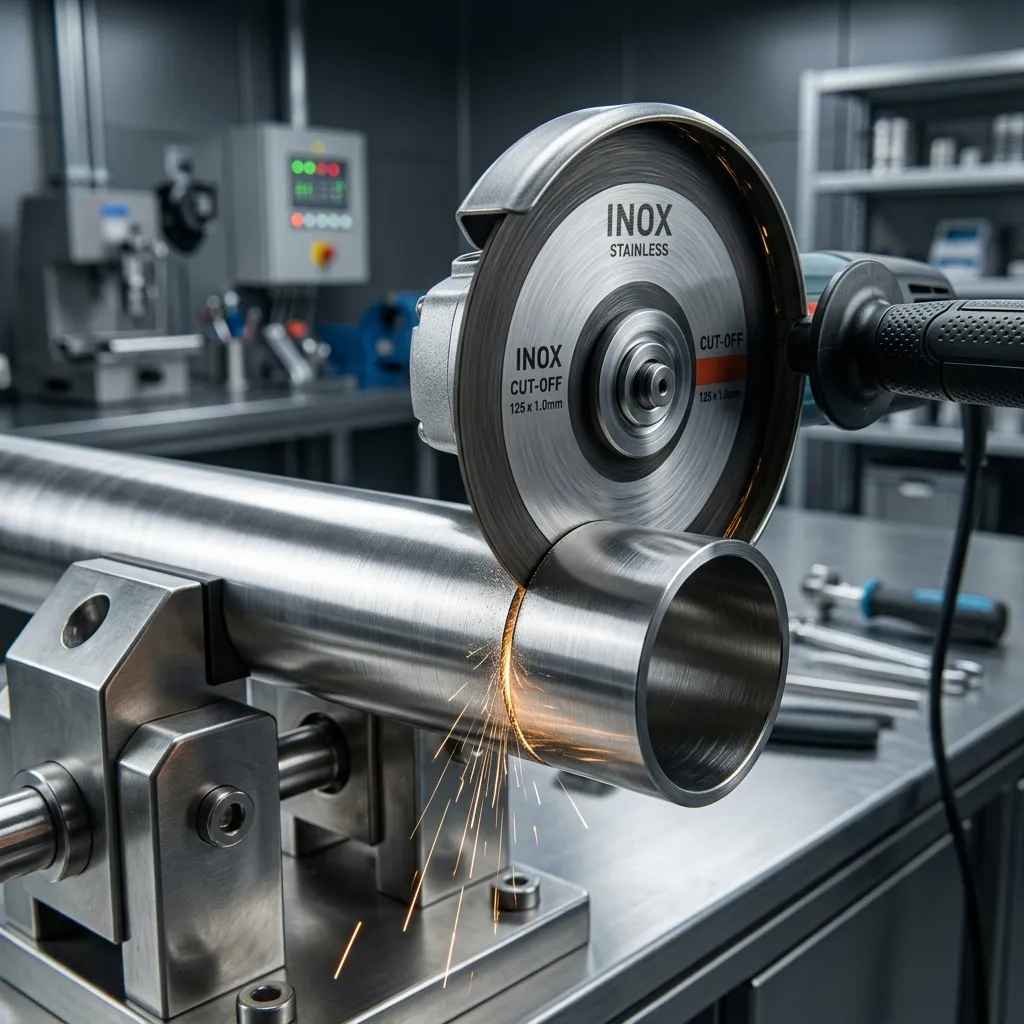
Why Stainless Steel Requires Dedicated Cutting Wheels
Stainless steel derives its corrosion resistance from the chromium oxide passive layer on its surface. This layer is disrupted by:
- Ferrous contamination - Iron particles from standard cutting wheels embed in the stainless steel surface and oxidise, causing brown staining
- Heat - Excessive heat during cutting causes heat tinting (rainbow discolouration) and sensitisation - the formation of chromium carbides at grain boundaries that permanently reduces corrosion resistance
Standard aluminium oxide cutting wheels are manufactured with iron-containing abrasive blends. They are not suitable for stainless steel cutting in applications where contamination and discolouration cannot be tolerated.
The Volcano INOX Specification
Apidor's Volcano brand ultra-thin INOX wheels are specifically engineered for stainless steel:
| Parameter | Specification |
|---|---|
| Abrasive | Iron-free Aluminium Oxide |
| Bond | Iron-free, Sulphur-free, Chlorine-free |
| Thickness | 1.0 mm – 2.0 mm |
| Diameter | 100 mm – 230 mm |
| Reinforcement | Double reinforced fibreglass |
| Certification | EN 12413 |
Why Iron-Free Matters
Every component of a Volcano INOX wheel - the abrasive grain, the bond, and the filler - is selected specifically to eliminate iron contamination at the cut face. This meets the requirements of:
- Food processing equipment fabrication (SS 304, SS 316L)
- Pharmaceutical plant construction
- Architectural stainless steel (decorative handrails, cladding)
- Chemical plant piping systems
Cutting Technique for Best Results
- Do not force the wheel - Let the wheel cut at its natural rate. Forcing increases heat generation.
- Keep the wheel moving - Stationary contact builds heat. Use smooth, steady strokes.
- Never use a used carbon steel wheel on stainless - Even a wheel used once on mild steel carries ferrous particles.
- Dedicate wheels - Keep your INOX cutting wheels separate from general cutting wheels. Label them.
- Let the cut cool - For long cuts, pause to allow the workpiece edge to cool.
Storage and Shelf Life
Organic bonded wheels (resinoid bond) absorb moisture, which weakens the bond matrix. Store all INOX wheels:
- In original packaging until use
- In a dry environment (below 65% RH)
- Away from direct sunlight and solvents
- Horizontal or on edge - never stacked flat under weight
EN 12413 specifies a maximum shelf life of 3 years from date of manufacture for resinoid bonded wheels.
Contact Pooja Abrasives for current stock of Volcano INOX wheels in standard sizes.