
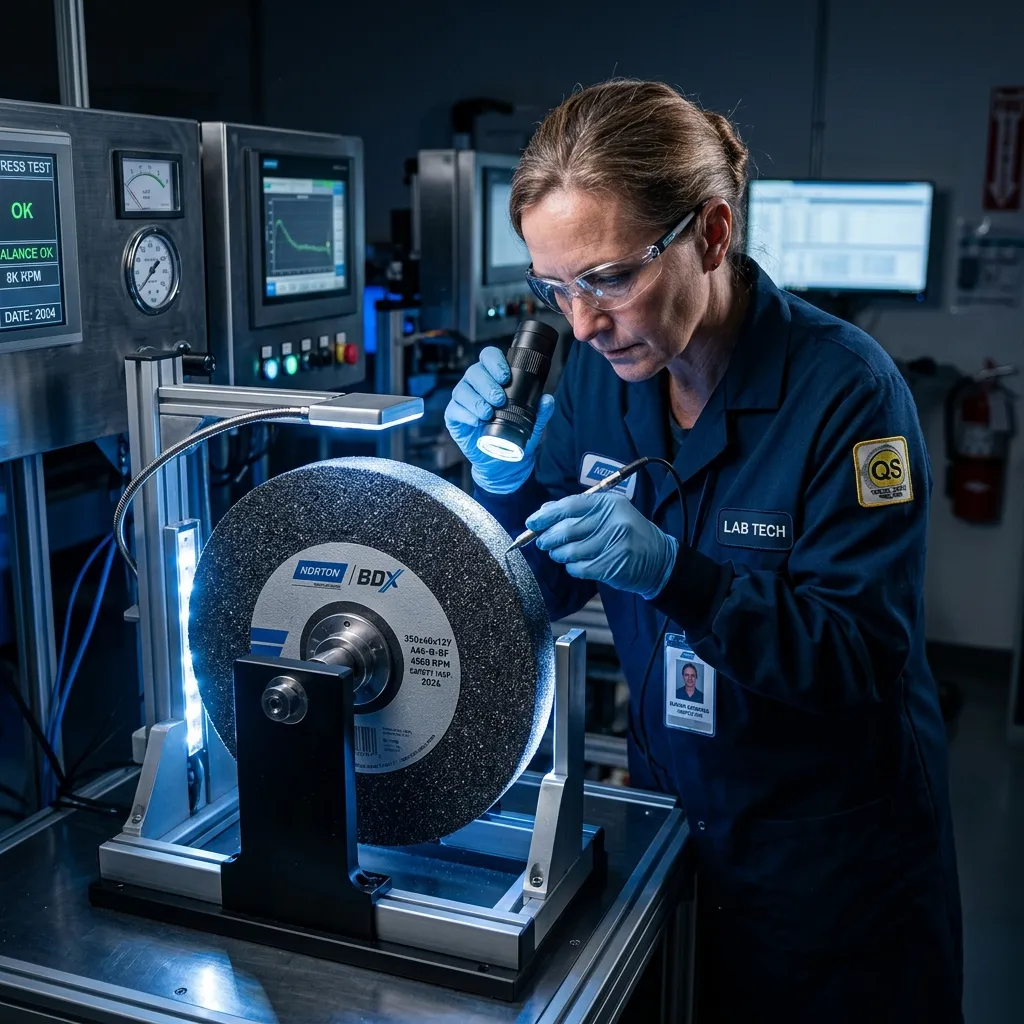
What Is EN 12413?
EN 12413 is the European standard published by the European Committee for Standardisation (CEN) that specifies safety requirements for bonded abrasive products. It applies to all bonded abrasive wheels - grinding wheels, cut-off wheels, and speciality wheels - used in professional industrial environments.
The standard covers:
- Maximum operating speed - Every wheel must be marked with its maximum permissible peripheral speed (m/s).
- Burst testing - Wheels must be proof-tested to a multiple of operating speed before supply.
- Dimensional tolerances - Diameter, thickness, and bore specifications must be within defined limits.
- Marking requirements - Required markings: max speed, abrasive specification, safety warning.
- Storage and shelf life - Organic (resinoid) bonded wheels have defined shelf life limits.
Why EN 12413 Matters for Procurement
Legal and Insurance Liability
In India, the use of certified abrasive products on workplace machinery is linked to occupational safety compliance under the Factories Act. If an uncertified wheel fails and causes injury, the employer - not the wheel supplier - typically bears primary liability for using non-compliant equipment.
Technical Performance Baseline
EN 12413 certification is not just about safety. The testing regime it mandates - burst speed, balance testing, dimensional checks - is the same regime that catches manufacturing defects before a wheel reaches the market. Certified wheels have passed this filter. Uncertified wheels have not.
Railways and Infrastructure Tenders
RDSO - the technical authority for Indian Railways - specifies EN 12413 compliance as a precondition for abrasive products used in railway maintenance. Most defence and government tenders now reference EN 12413 compliance in their technical specifications.
What Happens With Non-Certified Wheels?
Uncertified grinding wheels from unregistered manufacturers present the following documented risks:
- Under-speed failure - Wheel fractures at speeds below rated maximum due to manufacturing defects
- Unbalanced wheel - Causes machine vibration, accelerated spindle bearing wear, and operator fatigue
- Incorrect formulation - Claimed grit and bond do not match actual specification
How to Verify EN 12413 Compliance
- Request the certificate of conformity from your supplier - it should reference the issuing body (notified body or manufacturer declaration)
- Check the wheel marking - EN 12413 compliant wheels display the standard reference and max speed
- For Apidor products, certification documentation is available from Pooja Abrasives on request
All Apidor products supplied by Pooja Abrasives carry EN 12413 certification. Contact us for documentation.